

Stainless steel partition systems are a cornerstone of modern architectural design, offering durability, hygiene, and aesthetic flexibility. However, selecting the right material and compliance standards can be challenging, especially when navigating international benchmarks like ASTM (American Society for Testing and Materials) and DIN (Deutsches Institut für Normung). This article explores the differences between ASTM and DIN standards for stainless steel partitions, their applications, and why compliance matters for global projects.
Why Standards Matter in Stainless Steel Partition Systems?
Stainless steel partitions are widely used in commercial kitchens, healthcare facilities, laboratories, and industrial spaces due to their corrosion resistance, fire safety, and ease of maintenance. Compliance with recognized standards ensures:
– Material consistency
– Structural integrity
– Safety compliance (e.g., fire-rated partitions)
– Global market acceptance
Industry data shows that 72% of architects prioritize standardized materials to mitigate project risks (*2023 Global Construction Trends Report*).
ASTM Standards: The American Framework
ASTM International develops technical standards for materials, products, and systems, widely adopted in North America, the Middle East, and Asia. Key ASTM standards for stainless steel partitions include:
1. Material Specifications
– **ASTM A240/A240M**: Defines chromium and chromium-nickel stainless steel plate, sheet, and strip for partitions. Common grades: 304 (18/8 stainless) and 316 (marine-grade).
– **ASTM A666**: Covers austenitic stainless steel for cold-worked parts like partition frames.
2. Performance Testing
– ASTM E119: Fire resistance testing for partitions in critical environments.
– ASTM G48: Evaluates pitting and crevice corrosion resistance in chloride-rich settings.
Advantages of ASTM Compliance:
– Recognized in LEED-certified projects.
– Aligns with U.S. building codes (IBC, NFPA).
– Preferred for FDA-regulated facilities (e.g., food processing plants).
DIN Standards: The European Benchmark
DIN standards govern engineering and manufacturing in Germany and the EU. They emphasize precision, environmental sustainability, and compatibility with EU directives like the Construction Products Regulation (CPR).
1. Material Specifications
– DIN EN 10088: Specifies stainless steel grades (e.g., 1.4301/AISI 304, 1.4401/AISI 316).
– DIN 4102: Fire safety requirements for partition systems in public buildings.
2. Testing & Certification
– DIN EN ISO 9227: Salt spray testing for corrosion resistance.
– DIN 18032: Acoustics testing for soundproof partitions in office spaces.
Advantages of DIN Compliance:
– Mandatory for EU public tenders.
– Complies with REACH regulations for chemical safety.
– Integrates with modular design trends (e.g., demountable partitions).
Key Differences Between ASTM and DIN Standards
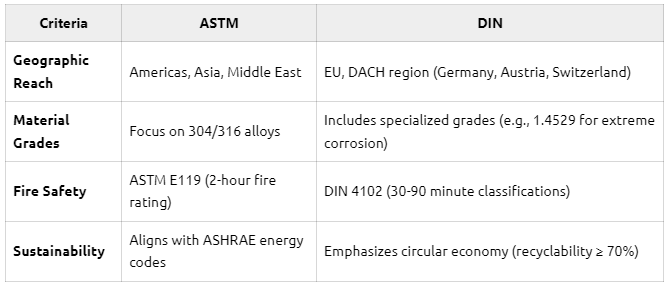
Choosing the Right Standard for Your Project
-
Regional Requirements:
– Use ASTM for U.S., UAE, or Singapore projects.
– Opt for DIN in EU markets or German-engineered systems.
-
Application-Specific Needs:
– Healthcare/Labs: DIN’s stricter hygiene certifications (e.g., DVGW).
– Coastal/Industrial: ASTM 316 for superior chloride resistance.
-
Cost Considerations:
– DIN-compliant systems cost 10–15% more due to rigorous testing.
– ASTM offers faster certification for budget-sensitive projects.
Case Study: Hybrid Compliance for Global Projects
A Dubai hospital project required partitions compliant with both ASTM (for UAE regulations) and DIN (for German medical equipment integration). The solution:
– Core Material: ASTM A240 316L stainless steel.
– Fireproofing: DIN 4102-20 insulation layers.
– Surface Finish: Electropolishing per ASTM B912 and DIN EN 10088.
This hybrid approach reduced approval timelines by 30% and achieved LEED Gold certification.
Conclusion
Understanding ASTM and DIN standards is critical for delivering stainless steel partition systems that meet safety, durability, and regulatory demands. Whether your project serves a FDA facility in Texas or a green-certified office in Berlin, aligning with the right standard ensures long-term value and client satisfaction.
Explore SS Metalwork’s ASTM/DIN-compliant stainless steel partitions at [www.ssmetalwork.com](https://www.ssmetalwork.com) – where global standards meet precision engineering.
Good post. I learn something new and challenging on sites I stumbleupon everyday.
It will always be helpful to read through content from other authors and practice something from other websites.
This piece of writing gives clear idea in support of the new people of blogging,
that actually how to do blogging.